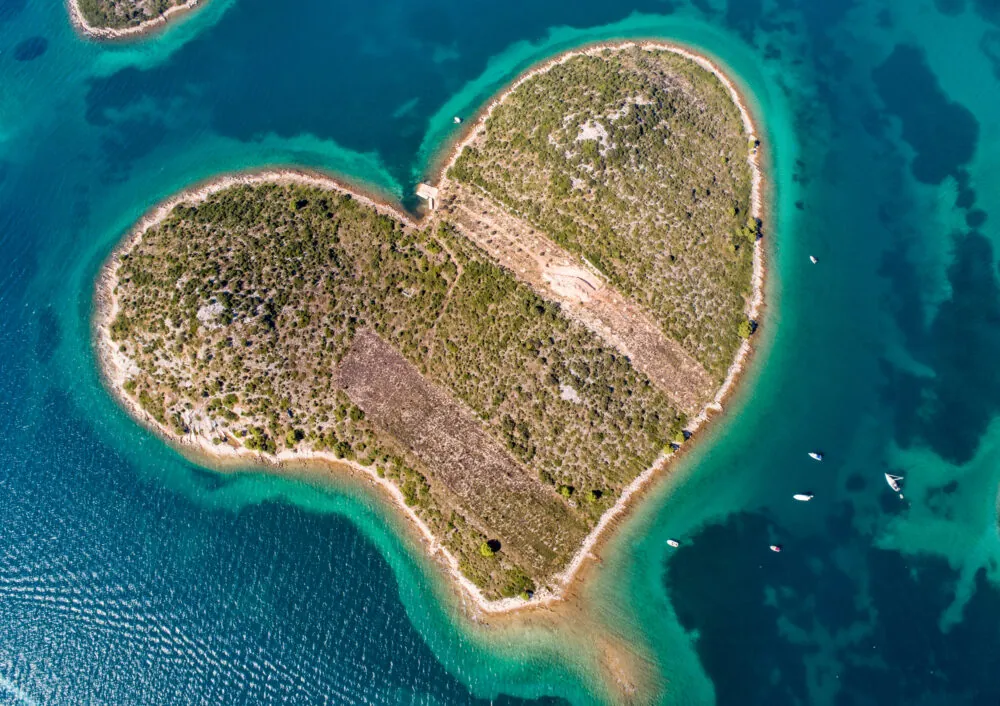
A heart-shaped island you can’t land on. A lake 287 metres deep that you can only look at from the road. Then a village built inside a waterfall. None of these are on the standard Split-to-Dubrovnik coast run, so they’re worth the detour.
I’ve pulled together three real, specific spots that are still under-covered. Galešnjak is the private heart-shaped island near Zadar. Imotski has twin sinkhole lakes inland from Split, while Rastoke is the watermill village outside Plitvice. So here’s what’s actually true about each one. Then I’ll show where they fit if you’re already planning a trip around the coast or the lakes.
| Spot | Nearest base | How you actually see it | Real caveat |
|---|---|---|---|
| Galešnjak | Zadar, Biograd or Sukošan | Boat tour or private charter, viewed from the water | Privately owned, no dock, no free landing |
| Imotski, Red Lake | Split, about 86 km | Roadside rim, no descent | No path down, 15 minutes covers it |
| Imotski, Blue Lake | Split, about 86 km | Walk down into the sinkhole, swim in summer | Water level swings by season, can run dry |
| Rastoke | Slunj, about 32 km from Plitvice | Walk the public streets and bridges | Closer viewpoints run on a paid loop |
Galešnjak: the heart-shaped island you can’t land on
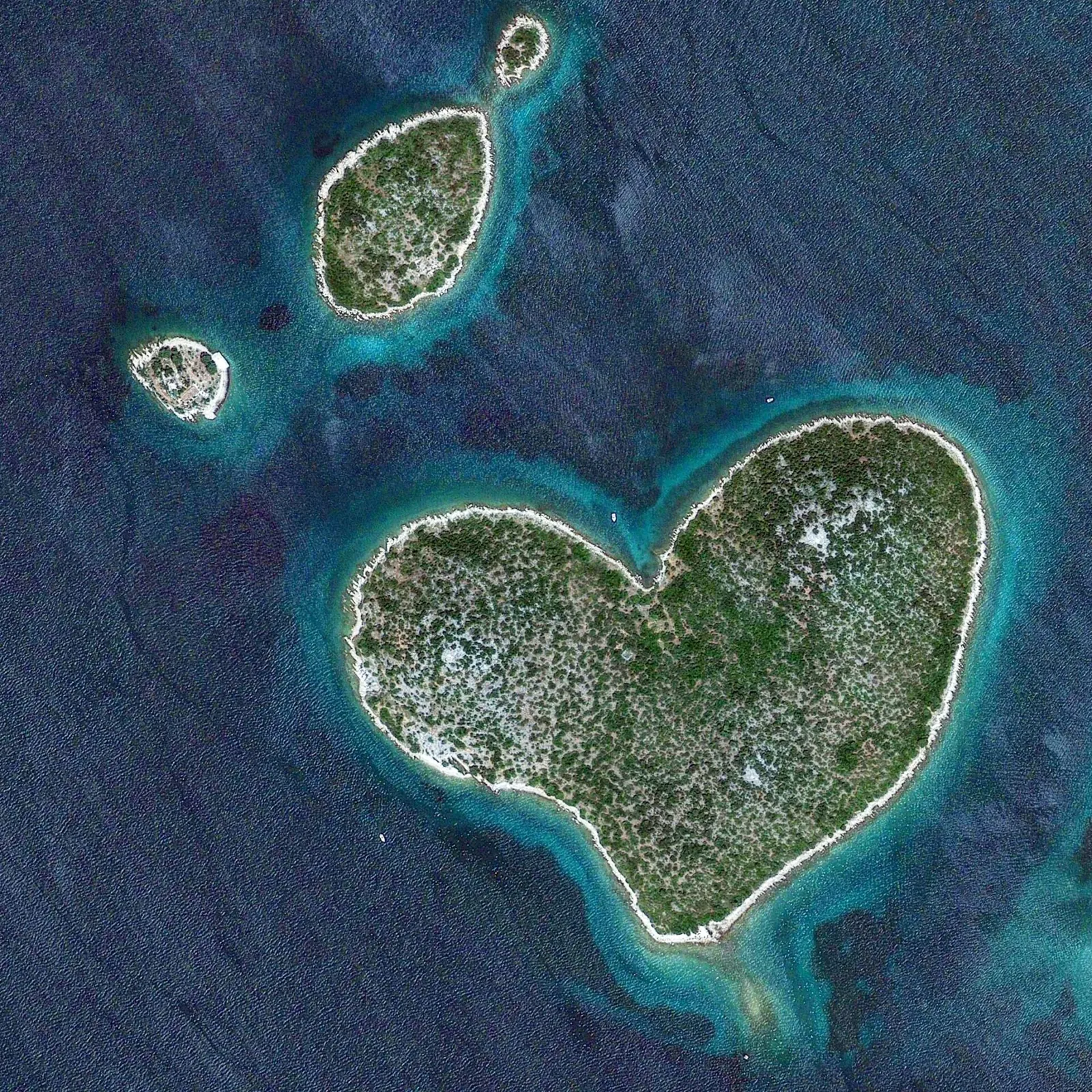
What it is
Galešnjak sits in the Pašman Channel, about half a kilometre off Turanj on the Biograd riviera. It’s also roughly 20 minutes’ drive south of Zadar. From the air, it’s a near-perfect heart. But from a boat, it’s a small, scrubby, uninhabited island with pebble edges and not much else.
The island is privately owned by the Jureško family, who live in Mrljane on nearby Pašman island. There’s also no dock, no path, and no official landing site. Short boat visits close to shore are common and generally tolerated. But you’re not free to land, camp, or build a fire, and permission is required for anything beyond a quick stop. So treat it as something you view from the water, rather than somewhere you disembark for a picnic.
Besides, there isn’t much on it anyway. You could walk the whole island in under ten minutes before you ran out of things to see. Expect low Mediterranean scrub, a scatter of pebble beach, rabbits, and wild pigeons. But there are no cafes, no souvenir stand, no infrastructure of any kind.
How to actually see it
Galešnjak’s fame is oddly recent, though the shape is old. French cartographer Charles-François Beautemps-Beaupré charted it as a heart back in 1806. It appeared in an atlas of the Dalmatian coast made for Napoleon’s navy. It sat there as a minor curiosity for two centuries until 2009, when someone spotted the shape on Google Earth. Then CNN and the BBC picked it up. The Huffington Post called it “the world’s most adorable island,” and since then it’s been “the island of love.”
So the realistic way to see it is by boat, from Zadar, Sukošan, or Biograd. Local operators run half-day and full-day trips through the Zadar archipelago that pass Galešnjak along with other small islands. Some also stop nearby for swimming. However, I couldn’t confirm a GetYourGuide listing built specifically around Galešnjak. If that matters to you, check what a Zadar boat tour actually includes before booking, rather than assuming it stops there. May to September is the easiest sailing window. Still, June and September offer calmer water and fewer boats than peak July and August.
Imotski: two lakes, and only one you can swim in
Imotski is a small hinterland town about 86 km from Split by road. It’s roughly an hour and ten minutes’ drive inland via Sinj. It’s not on the coast at all, which is also part of why it stays off most first-time itineraries. Two sinkhole lakes sit right at the edge of town, but they behave completely differently from each other.
Red Lake: the one you look at
Red Lake (Crveno Jezero) is the one you look at, rather than the one you visit. The full sinkhole runs to roughly 530 metres deep, with cliff walls rising over 241 metres above the water. The lake itself, though, averages around 245 metres deep and reaches a maximum of about 287 metres. That makes it one of the deepest lakes in Europe. There’s no safe path down, so you view it from the roadside rim, free of charge. Fifteen minutes covers it.
Blue Lake: the one you can swim in
Blue Lake (Modro Jezero) is the accessible one, a short walk from Red Lake and right beside Imotski’s Topana fortress. A path descends into the sinkhole to the shoreline. In summer, when the water sits around 20 to 21°C, it’s genuinely swimmable. But the level swings hard with the seasons. Spring snowmelt can push it up to around 90 metres deep (it hit 114 metres once, in 1914, and overflowed). Meanwhile, late summer sometimes drains it almost completely, leaving a dry basin that locals have historically used for football matches. Imotski’s own football stadium, Stadion Gospin dolac, also sits on the rim right above it. The BBC has named it one of the world’s most scenically located grounds.
Don’t assume Blue Lake will have water when you show up. If you’re planning a swim specifically, check conditions closer to your travel dates rather than building the whole trip around it.
Getting here without a car is the real friction point. Public transport to Imotski from Split is limited, so most visitors book it as an organised trip. This tour from Split combines the lakes with a stop at Winery Grabovac. It’s a reasonable way to see both lakes while tasting something local in one afternoon.
If you’d rather skip the winery stop, this Split departure focuses on the lakes with a wine tasting built in at a different point. Both run around five hours door to door. So either fits into a single day trip from the Split area without an overnight.
Rastoke: the village built into a waterfall
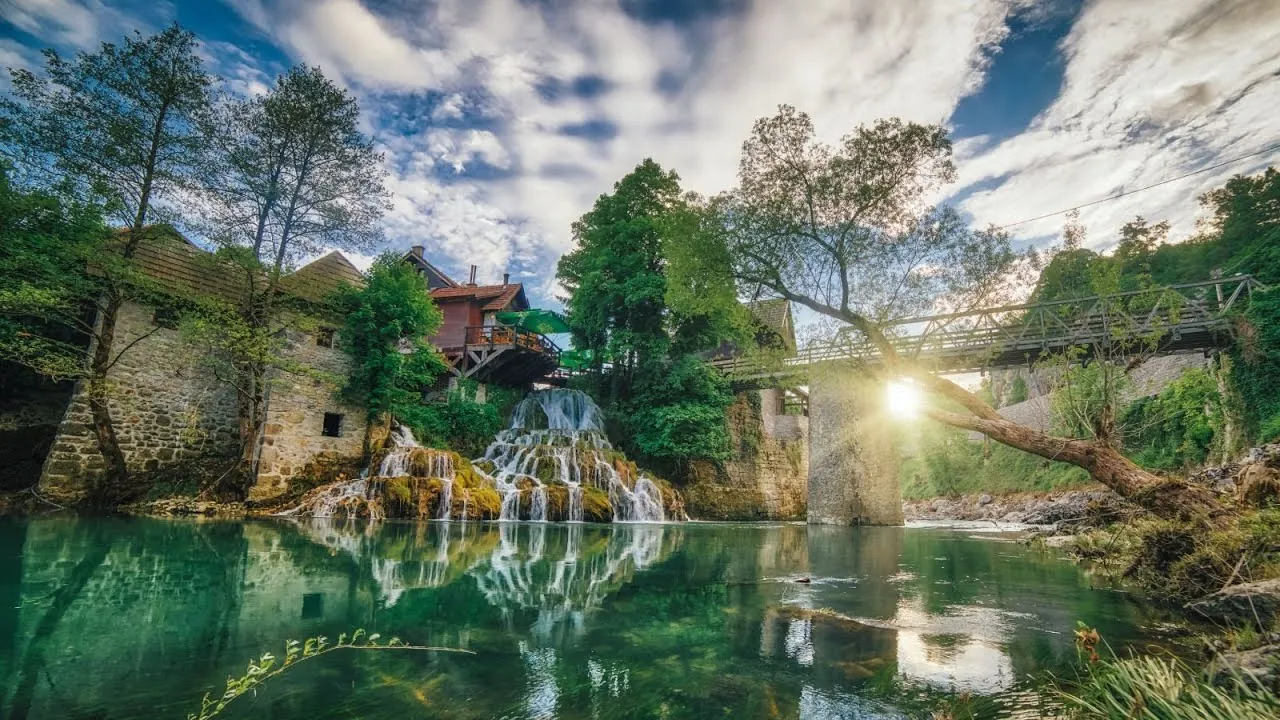
Rastoke sits at the confluence of the Slunjčica and Korana rivers, in the small town of Slunj. It’s about 32 km and roughly a 30-minute drive from Plitvice Lakes National Park. If you already have Plitvice tickets booked, this is a genuinely easy add-on rather than a special trip.
The river drops through a travertine barrier around 500 metres wide and 200 metres long. It then splits into roughly 23 small waterfalls that fall 10 to 20 metres into the Korana below. Old watermills sit directly on the rock, wood and stone buildings perched over the moving water. The village once had up to 22 working mills, dating back to the 17th century. Most of the standing houses today are from the late 19th and early 20th centuries, though a few are still lived in.
You can walk the public streets, bridges, and several viewpoints for free. That still gets you a real sense of the mills and the canyon. Some closer viewpoint areas run on a paid loop, so budget a bit extra if you want to get right up next to the falls rather than viewing from the bridges.
From Zagreb, it’s about 104 to 110 km, roughly an hour and a half by car. By bus, it’s about 1 hour 40 minutes to Slunj, and then a 10-minute walk into the village. Still, pairing it with Plitvice makes more sense than visiting it on its own.
Where these fit with the rest of hidden Croatia
None of these three are isolated curiosities. Instead, they sit inside a wider pattern of Croatia spots that get real search interest but almost no dedicated coverage. I’ve also written about a few of the others already.
If you like the idea of a place you view rather than walk through, Zavratnica Bay below the Velebit mountain is the coastal version. It’s a narrow, protected inlet you swim in, rather than a lake you look down into. But if Imotski’s history interests you more than its geology, Goli Otok covers a very different kind of hidden Croatia. It’s a former Yugoslav prison island in the northern Adriatic, but it’s now open to seasonal boat visits.
Also, for more natural formations away from the coast, this guide to five caves worth visiting in Croatia covers underground spots that get the same treatment as Imotski’s lakes: real, dramatic, and rarely on a first-timer’s list. If you’re drawn to the history angle rather than the landscape one, the story of Glagolitic, the oldest Slavic alphabet traces a piece of Croatian heritage most visitors never hear about at all.
If you’re building this into a wider inland-and-coast route, pair Rastoke with the Plitvice Lakes guide for the park itself. Since the two sit close enough together, you can do them in the same day.