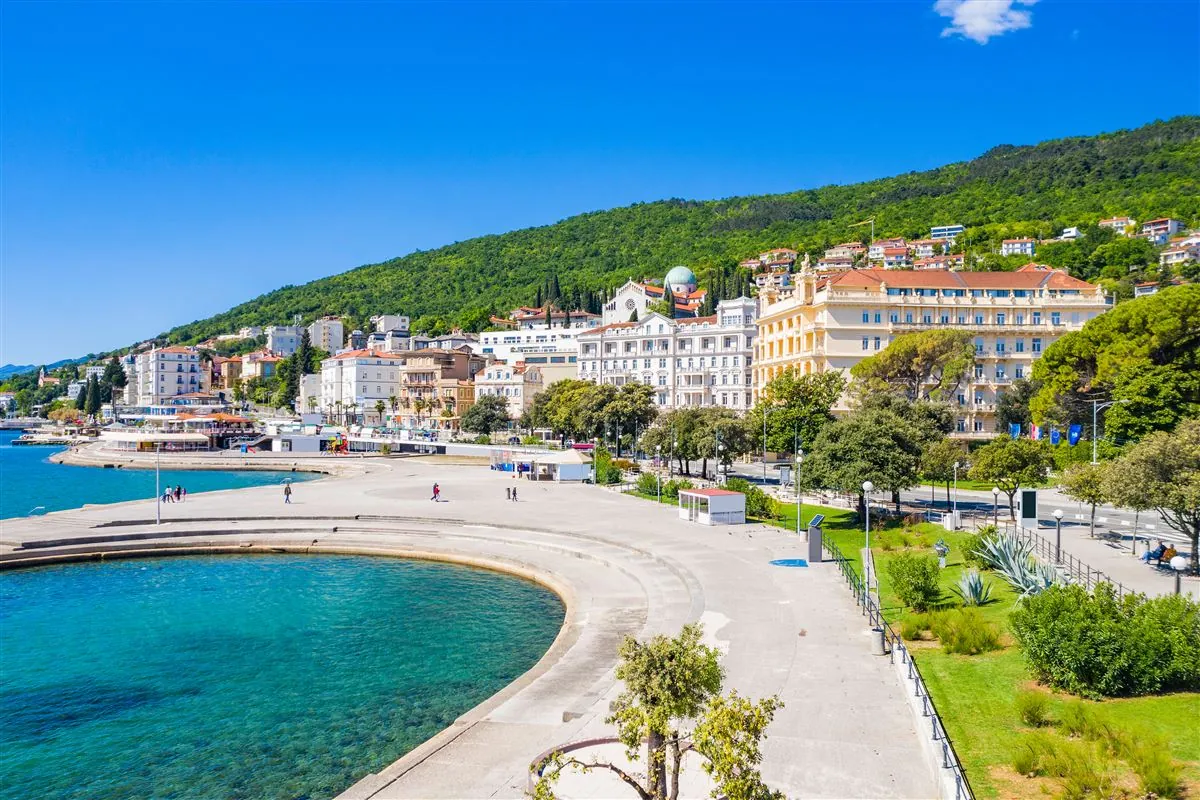
Opatija doesn’t have a single beach that ends up on a Croatia bucket list. It has a 12km seafront walkway instead, a park built in 1845, and a coastline that was the Adriatic’s most fashionable address before Dubrovnik or Hvar were on anyone’s map. Still, that’s a genuinely different pitch from the rest of the coast.
I’d send someone here who wants Croatia without a ferry timetable. That’s because Opatija sits on the mainland, 40km from Rijeka Airport by road. It also connects on foot to two towns worth a half-day each: Lovran and Volosko.
Quick answer: is Opatija worth visiting?
Yes, especially if you want a slower, greener version of coastal Croatia. Opatija suits travelers who’d rather walk than drive. It also suits people who like Habsburg-era architecture and don’t need a headline beach to justify a stop.
It’s a weaker fit when you’re chasing Dalmatia’s white limestone islands and turquoise coves. Opatija’s water is clean, but the coastline here is rockier. So the pull is the town and the walk, not the swimming.
Why Opatija became Croatia’s Habsburg-era resort town
Opatija’s first building was Villa Angiolina, built in 1844 by Rijeka businessman Iginio Scarpa as a summer residence. Then he spent the next 15 years, from 1845 to 1860, planting the English-style garden around it. Overall, more than 150 plant species went in, brought from as far as Japan, South America and Australia.
One of those imports, the Japanese camellia, later became the town’s official tourism symbol. The garden still surrounds the villa today and is free to walk through. It also has views out over the Kvarner Bay to Krk and Cres.
In 1889, Emperor Franz Joseph I formally declared Opatija a climatic health resort. As a result, a fishing village became the winter retreat for Austro-Hungarian aristocracy.
Hotel Kvarner, the first purpose-built resort hotel, broke ground in 1884. Then grand villas followed along the seafront through the 1890s and 1900s.
The visitor list from that era reads like an index of European culture. Composer Gustav Mahler, opera composer Giacomo Puccini and writer Anton Chekhov all spent time here. When you walk the row of yellow and cream villas between the harbour and Villa Angiolina, you’re looking at buildings most of them would recognise.
If you only do one thing besides walking the seafront, book a guided walk through this history. This half-day Kvarner Bay tour covers both Opatija’s old town and Rijeka. It’s a useful way to get the Habsburg-era context before you’re wandering the Lungomare on your own.
Walking the Lungomare: Opatija to Lovran and Volosko
The Lungomare, officially the Franz Joseph I Promenade, is a 12km paved coastal path. It runs from Volosko in the north to Lovran in the south, while Opatija sits roughly at its centre. The path is flat and wheelchair and stroller-friendly. It’s also lined with the same belle-époque villas and pine trees that gave the town its reputation.
You don’t need to walk all 12km in one go, since Opatija to Lovran is about 5km one-way. That’s roughly 90 minutes at an easy pace. In fact, it’s the stretch most people actually walk.
Lovran is the chestnut town. Local maruni chestnuts are larger and easier to peel than the standard variety. In fact, they were exported to Vienna and Berlin as a delicacy back in the 19th century.
The Marunada chestnut festival is still the reason locals plan an autumn trip here. It runs across three weekends every October, while the main weekend is in Lovran itself. In 2026 that’s October 9 to 11.
Volosko sits the other direction, a 20 to 25 minute walk north of central Opatija. It’s a working fishing harbour, small enough to see in an hour, but it punches well above its size on food.
Plavi Podrum is the Michelin-recommended name locals mention first. It’s also been serving Adriatic seafood from that harbour for decades.
Between the two, you get a genuinely different day than a beach town offers. Walk to Volosko for lunch in the morning, back through Opatija in the afternoon, on to Lovran for a coffee before the light drops. No car, no ferry, no timetable to check.
| Town | Distance from Opatija | Known for | Best for |
|---|---|---|---|
| Volosko | 20-25 min walk north | Fishing harbour, Michelin-recommended seafood | A half-day, food-focused stop |
| Opatija | Centre point | Villa Angiolina, belle-époque hotels, Lungomare | Basing yourself for the whole coast |
| Lovran | About 90 min walk south (5km) | Maruni chestnuts, October Marunada festival | A longer walk or an autumn trip |
None of the three need a car to reach each other, since the Lungomare connects all three on one continuous, flat path. That’s particularly unusual for this stretch of the Croatian coast.
Kvarner vs Dalmatia: why this coast looks different
The Kvarner coast is the greenest stretch of Croatia’s Adriatic. Učka mountain rises directly behind Opatija, forested right down to the water. Meanwhile, the Dalmatian islands further south show bare white limestone.
That greenery is the actual difference, not just a scenery note. Dalmatia’s islands are dry, rocky and largely treeless because of centuries of grazing and a harsher microclimate.
Kvarner’s hills hold onto forest cover instead. It’s also why the region stays noticeably cooler in peak summer than Split or Dubrovnik.
There’s a practical difference too. Opatija, Lovran and Volosko are all mainland towns connected by road. So you’re not planning around a Jadrolinija ferry schedule the way you would to reach somewhere like the Zadar archipelago, where three of the six islands only run on seasonal boat lines.
If you do want to add an island day from here, this boat trip from Opatija or Lovran to Cres gets you to secluded coves on Cres. It also skips the logistics of a multi-day island stay.
Getting to Opatija and the best time to visit
Rijeka Airport (IATA code RJK) is actually on the island of Krk, but the Krk Bridge connects it to the mainland. It’s about 40km from Opatija by road, roughly 38 to 40 minutes by car or taxi.
There’s no direct rail link into Opatija itself. So most visitors drive, take a taxi, or connect via Rijeka’s bus station, about 15km away. If you’re planning to explore beyond the Lungomare, renting a car makes the wider Kvarner region, from Mošćenička Draga to Krk and Cres, far easier than relying on local buses.
Driving from Zagreb is the other common route in. It’s about 175km via the A1 and A6 motorways, roughly 2 hours depending on traffic. The drive itself is part of the appeal: continental plains give way to the Gorski Kotar mountains before you drop down to the coast.
May, June, September and October are the best months. Temperatures sit between 18°C and 25°C, while the sea is warm enough to swim without being crowded. Hotel prices also drop from peak-season rates.
July and August bring the warmest sea, 21 to 24°C, and the most stable weather. They also bring the most visitors and the highest prices.
February is genuinely off-season, with the coldest temperatures of the year. As a result, most restaurants and hotels operate on reduced hours. September and December are also the rainiest months on average, worth checking forecasts around even in an otherwise good shoulder-season window.
Basing yourself in Opatija for the wider Kvarner region
Opatija works as a base for more than the Lungomare towns. Mošćenička Draga, another half-hour south past Lovran, also has Sipar beach and its own network of forest walking trails up into Učka Nature Park.
If Plitvice Lakes is part of your route, it’s a realistic day trip from here. So you don’t need to plan it separately from Zagreb or Split. I’d read the Plitvice Lakes guide before you go, since entrance rules and the busiest trail sections change season to season.
This day tour departs from Opatija or Crikvenica and covers the drive both ways. Doing it yourself, though, is close to three hours each way.
Book accommodation directly in Opatija when you want to walk the Lungomare from your hotel door. Villas closer to Volosko tend to be quieter and cheaper than the central hotel row near Villa Angiolina. But the trade-off is a slightly longer walk into town for dinner.
If Plitvice is on your route from here, read the Plitvice Lakes guide before you book anything else. Overall, it’s the one addition to a Kvarner stay that’s worth the three-hour round trip.